Warlock of Firetop Mountain is possibly the most important book for me. I borrowed it from a local library when I was eleven or so, and was immediately hooked. I either bought or borrowed a load of gamebooks in my teens, including Lone Wolf, Sorcery!, Cretan Chronicles, Fatemaster and Endless Quest.
(... talking about early gaming story)
An interview with Paul Partington, author of gamebooks, including Temple of the Skull God (the Nov 2026 book for the 100 Endings Book Club). Latest in series of gamebook interviews.
Chat with Paul Partington
Paul Partington is the author of several gamebooks, including the Temple of the Skull God using the GNAT system, Rift: Herald of Oblivion for the Savage Realm series, Island of Fury using OSE and Village of the Damned using Dragon Warriors.
We have using the gnat system, writing for savage realms, favourite gamebooks, writing rpg gamebooks, and dragon warriors. Among other questions.
What was your gaming story before writing your first gamebook
Warlock of Firetop Mountain is possibly the most important book for me. I borrowed it from a local library when I was eleven or so, and was immediately hooked. I either bought or borrowed a load of gamebooks in my teens, including Lone Wolf, Sorcery!, Cretan Chronicles, Fatemaster and Endless Quest.
But gamebooks are a solitary pastime, and I got into Dungeons and Dragons - specifically, the Mentzer red box. This lead on to other rpgs, including Dragon Warriors (which were readily available in paperback in the 80s) and Warhammer (Fantasy Roleplay). Which inevitably lead to an interest in Warhammer 40,000 and Fantasy Battles.
I think its fair to say that chancing across Warlock in a library many years ago has lead to a lifetime of hobbies and meeting new people (not to mention spending a fortune on Warhammer miniatures!).
How did the your first gamebook come to be?
I wrote a fan Fighting Fantasy gamebook while I was at school. And then, when Wizard books republished fighting Fantasy, I was re-inspired and dug it out and extended it to the standard 400 sections I quite enjoyed the process, so I had a go at another one, called Return of the Lizard King.
About six years ago, I wrote Village of the Damned as another fan Fighting Fantasy gamebook. Dragon Warriors had been re-published and I noticed that Red Ruin had released a gamebook using that system, so I got in touch with the editor, the dedicated Simon Barns, and asked if they would like Village of the Damned, as the tone fit in with Dragon Warriors. He was kind enough to say yes, and that set the ball rolling.

What got you writing for the GNAT system?
Somebody commented that they enjoyed my gamebooks and wondered what I could do when not using the Dragon Warriors rules. I've always been fascinated with mythology, not just British folklore, but also from across the world, so I set to writing Temple of the Skull God.
My gamebooks were tending towards more open world, so I continued refining that approach. I wasn't sure what to do about the rules, but happily enough David M. Donachie had just developed the GNAT rules (which any gamebook writer can use - they're under Creative Commons) and I was quite taken with them.
People seemed to quite like it, so I carried on using the GNAT system for future gamebooks.
What was the process for writing your most recent gamebook for Savage Realms?
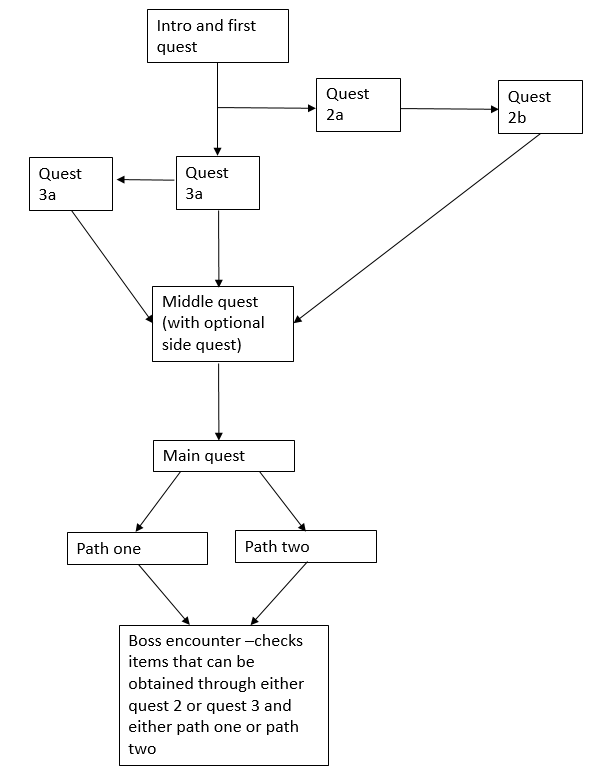
I knew I wanted a more linear approach for this one, rather than open world, but I also wanted to avoid 'one true path' and offer replayability. (See flowchart below.)
I also wanted to include as many different locations and encounters as I could - some from my own rpg or wargames, some inspired by mythology. So you might recognise my take on Ravenloft, or Arthurian legend, or Nurgle daemons from Warhammer.
What are your favourite gamebooks written by others?
This is a really hard question, because it depends on what mood I'm in! The good thing about gamebooks is the variety of different ways to play.
If I want a nice simple gamebook, I might go for Crypt of the Vampire or Temple of Terror. Or I might want to be immersed in the world, so I'll play Lone Wolf. If I want an extended period of play in an open world, there's Steam Highwayman by Martin Noutch, or Fabled Lands. Joe Cheal also writes some splendid open world books with a story and mystery to unravel.
I also enjoy gamebooks by James Hirons or Mark Lain, which are structured like Fighting Fantasy. Obviously, the Savage Realms series as a whole are excellent (particularly the most recent one!).
I also really like the gamebooks produced by fellow Dragon Warriors and GNAT author, the criminally overlooked David M. Donachie, who not only writes but also illustrates his books. He'll hate me for saying so, but I always look on his books with envy, and try to reach his lofty standards.
What's your relationship with the dragon warriors rpg?
I started playing in my teens, when the first paperback came out. I think we played through the scenarios in the first four books before we stopped.
I loved the feel of the world; medieval Europe with spiteful faeries and mist-shrouded ruins. I carried on playing at university, but as with many things in life, it gradually dropped off my radar. I was delighted when it was re-published, re-kindling fond memories of exploring haunted barrows.
What are the challenges of writing gamebooks for rpgs (such as OSE or Dragon Warriors)?
You have to be familiar with the rules, and what players might reasonably attempt to do within those rules. It helps to have playtesters that also know the rules (in one of my Dragon Warriors books, a playtester got around a lethal - or so I thought - situation by the judicious use of a spell I hadn't considered).
There is a certain expectation, I think, that what somebody might have encountered in one of their own group games plays out the same in a gamebook. So the rules for opening doors or climbing walls, for example, should be consistent.
But on the upside, you have a load of adventures - either ones you've run yourself, or published ones that you might have skimmed - for guidance. And monster stat blocks are readily available.
Do you still play gamebooks, and which type (open world, dungeon crawl/FF, horror, etc.) is your favourite.
(bonus question from Basti aus Hamburg on the Discord server)
I still play gamebooks and still have that rush when you open a new one. I'm afraid I can't give a definitive answer as to which type I prefer!
Sometimes I like to get a piece of paper and pencil and map out a dungeon or wilderness. Sometimes it's fun to return to books you've mapped out before and try them again without the maps.
But I also like open world and wandering around, perhaps revisiting previous books to see what I might have missed. It just depends what I fancy at the time.
What are your next big projects that you can talk about?
Caverns of the Netherearth is near to completion; all the art is finished, so I'm putting these in and finalising formatting as we speak.
Next up is probably a simple introductory GNAT adventure; I'd like to leave something in the school library when I leave.
And there's always more Dragon Warriors gamebooks on the horizon!
What's one surprising thing about you, not related to gamebooks
(Bonus question)
I'm a black belt in karate and still train every week.
Where can people find you online?
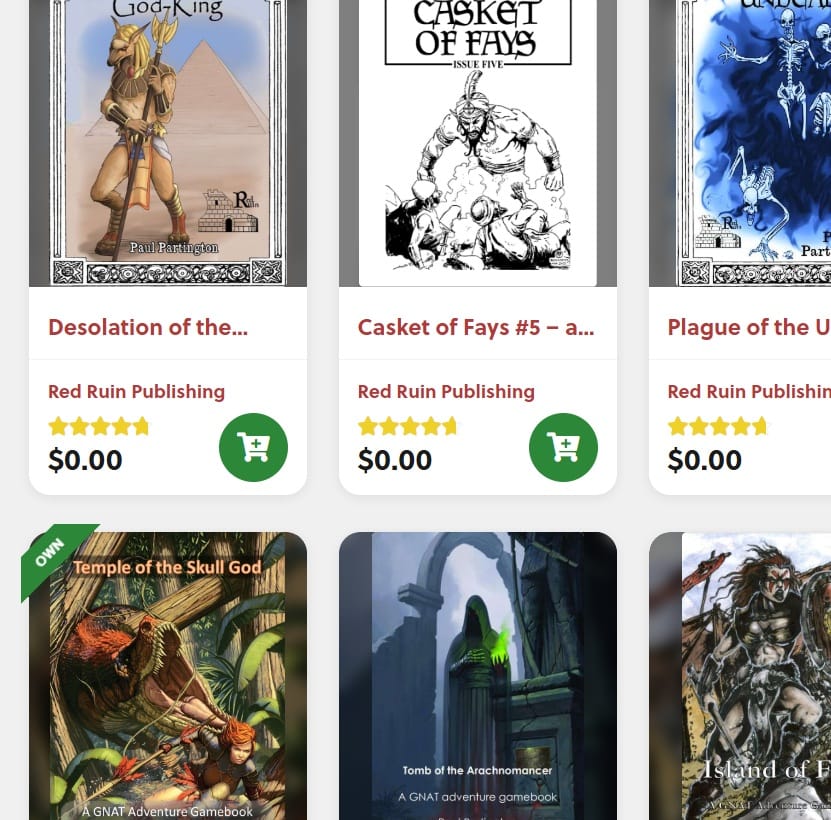
On DriveThruRPG and Amazon UK.
Is there anything else you would like to talk about?
Thank you for the opportunity for a chat and for including Temple of the Skull God as part of your book club!
(Temple of the Skull God came 2nd in the Dec 2025 poll and then was selected in the Oct 2026 poll)
Finishing Up
If you haven't tried one of Paul's gamebooks, track one down!
There are many more articles on Rand Roll. Plus the 100 Endings Discord. I also create Generators at Chaos Gen and have a monthly random tools Newsletter.