There was already enough complexity in wanting an environment that would develop over time, so adding dice in didn't feel to me like it would add anything. I didn't want it to be down to chance, I wanted it to be a delicious riddle with a satisfactory conclusion.
(... talking about Escape from Portsrood Forest)
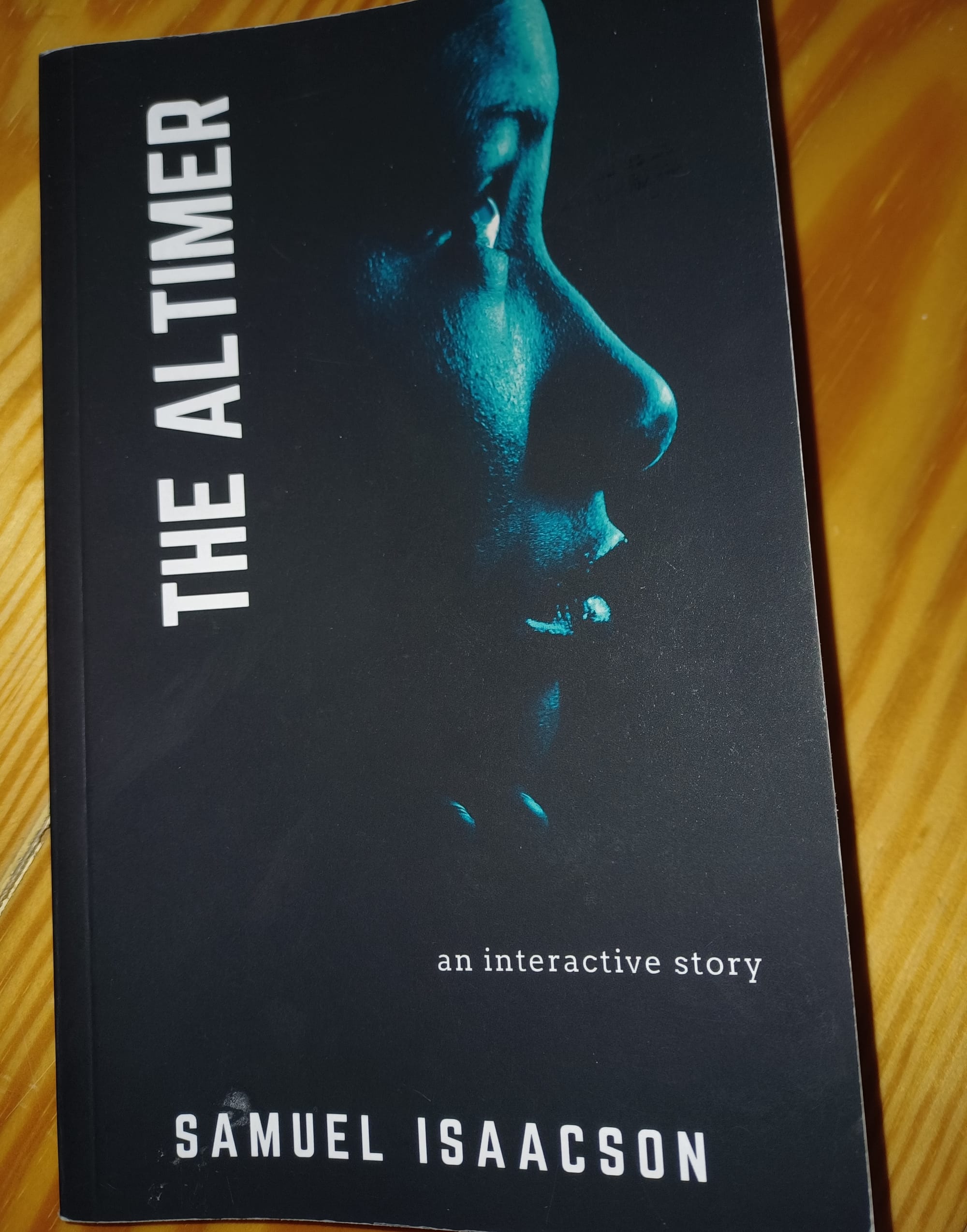
An interview with Samuel Isaacson, author of gamebooks, including the Altimer (the Oct 2026 book for the 100 Endings Book Club). Latest in series of gamebook interviews.
Chat with Samuel Isaacson
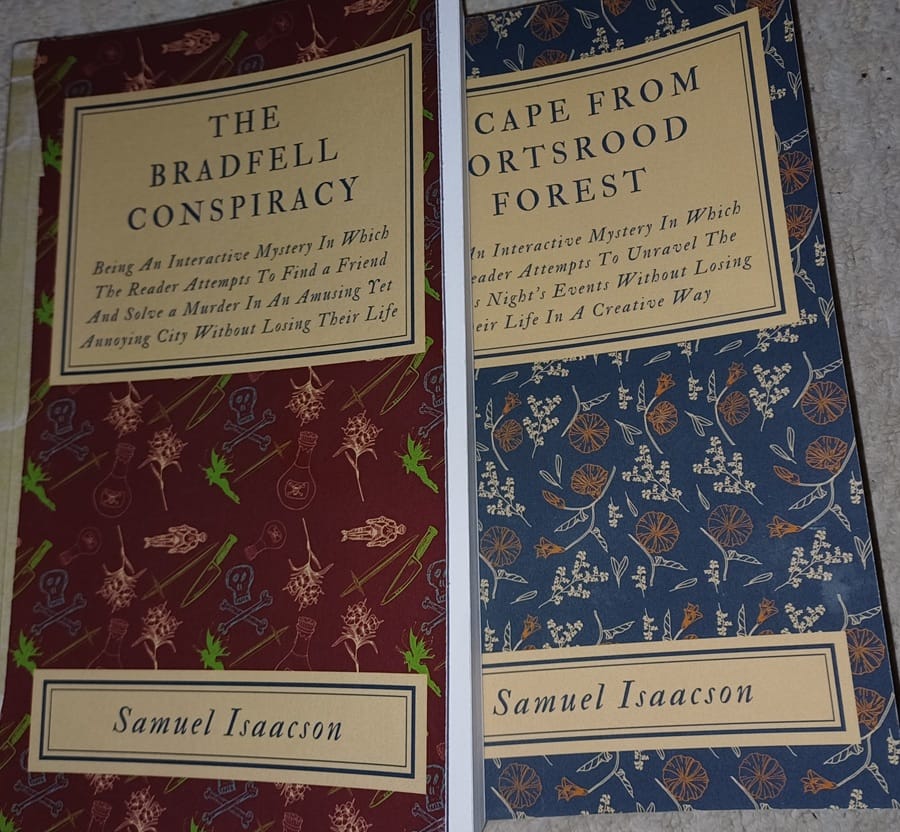
Samuel Isaacson is the author of several gamebooks, including the sci-fi Entram Epic, the murder mystery Bradfell Conspiracy and the diceless Escape from Portsrood Forest.
We have the creation the Altimer, writing a trilogy, favourite gamebook, writing a mystery, and proudest gamebook(s) to write. Among other questions.
What was your gaming story before writing the Altimer?
Gamebooks were a central part of my childhood, right the way through to me leaving home at 18. That focus of my gaming shifted to computer games in my twenties, and in the 2010s I became increasingly interested in tabletop roleplaying games.
Parallel to that journey was greater open-mindedness about genre. As a child, I knew I liked fantasy but thought that scifi was for people far nerdier than me and horror was for people made of sterner stuff! Growing up, I discovered that I'd actually loved both scifi and horror the whole time.
How did the Altimer come to be?
I heard Ian Livingstone describing his writing process, and thought to myself "I wonder if I could do that?". Over the course of the next few weeks I scribbled a 100-section gamebook for my children, proving to myself that I could do it!
I can't remember what the trigger was for me to commit to writing The Altimer but it was almost certainly something I'd seen on one of the gamebook Facebook groups, which I'd become a bit addicted to.
I drew on some of the worldbuilding sense I'd got from recent roleplaying experiences - particularly Skies of Glass and Degenesis - and a novel I was getting nowhere at all with, and The Altimer was born!
How much of the Altimer was seats-of-the-pantsed and how much carefully planned?
(Bonus question from Polemicus on the Discord Server)
The Altimer was pretty much fully planned before I started writing a single section. That's been the case with all of my books - knowing my personality, if I just started building I'd honestly never stop.
My first build was quite different - about a third was in training camp going through simulations, then almost all the rest on the ship and a tiny ending upon landing.
Some helpful feedback from a playtester led me to cut out a big chunk of the training and flesh out the finale quite a bit, which makes the action get underway a bit quicker and doesn't lead to such an abrupt end.
Does the Altimer have artificial gravity or not?
(Bonus question from Polemicus on the Discord Server)
Yes, a tricky question. This is, I assume, relating to some error I've made in not changing something from that rewrite!
My first version did have gravity, which meant that you were walking around the ship. Catalina was also male, and I think there might be a 'him' left in there from that.
It was meant to be a mystery resolved through discovering that the ship had actually crash-landed some time before, but once I'd made the decision to extend the ending I then needed to find a way to reconcile being in space with being able to walk around, and couldn't in a way that satisfied me.
The importance of good proofreading!
How different was New Gaia to write, as it was your 2nd gamebook and 2nd in a trilogy
It was different inasmuch as I was now writing with a clear outcome. The Altimer was writing purely for fun, as an experiment, New Gaia was writing with a view to seeing a book out there.
The actual process was effectively the same, although I'd learned plenty of lessons and now had the chance to introduce more complexity with more sections.
I'd also decided that if I'd write a second, I'd definitely write a third, so I wanted to introduce some loose ends that I knew I'd tie up. The idea of a finished trilogy was important to me as I don't really enjoy the experience of indefinitely-long series that may or may not ever conclude.
I wanted someone starting number one to know that number three was the end, and that reading the full story end-to-end was an option.
What are your favourite gamebooks written by others?
As a child I was obsessed with the Fabled Lands series. I spent more time in that world than pretty much anywhere else! And I also love a bunch of the Fighting Fantasy series, especially Creature of Havoc and Legend of Zagor - two quite different books.
I have to say, though, that on balance I'm probably a much bigger fan of the modern gamebook scene.
There's much more maturity and thought in the Steam Highwayman series (SH Interview) than there were in some of the 90s books. Both David Lowrie's and Victoria Hancox's stuff (VH Interview), while both disturbing in different ways, have demonstrated how immersive the genre can be. And Jonathan Green (JG Interview) is a consistent factory of high-quality, well-thought-through gamebooks.
When writing Escape from Portsrood Forest, what inspired you to go diceless?
Escape from Portsrood Forest was a lockdown-induced descent into silliness.
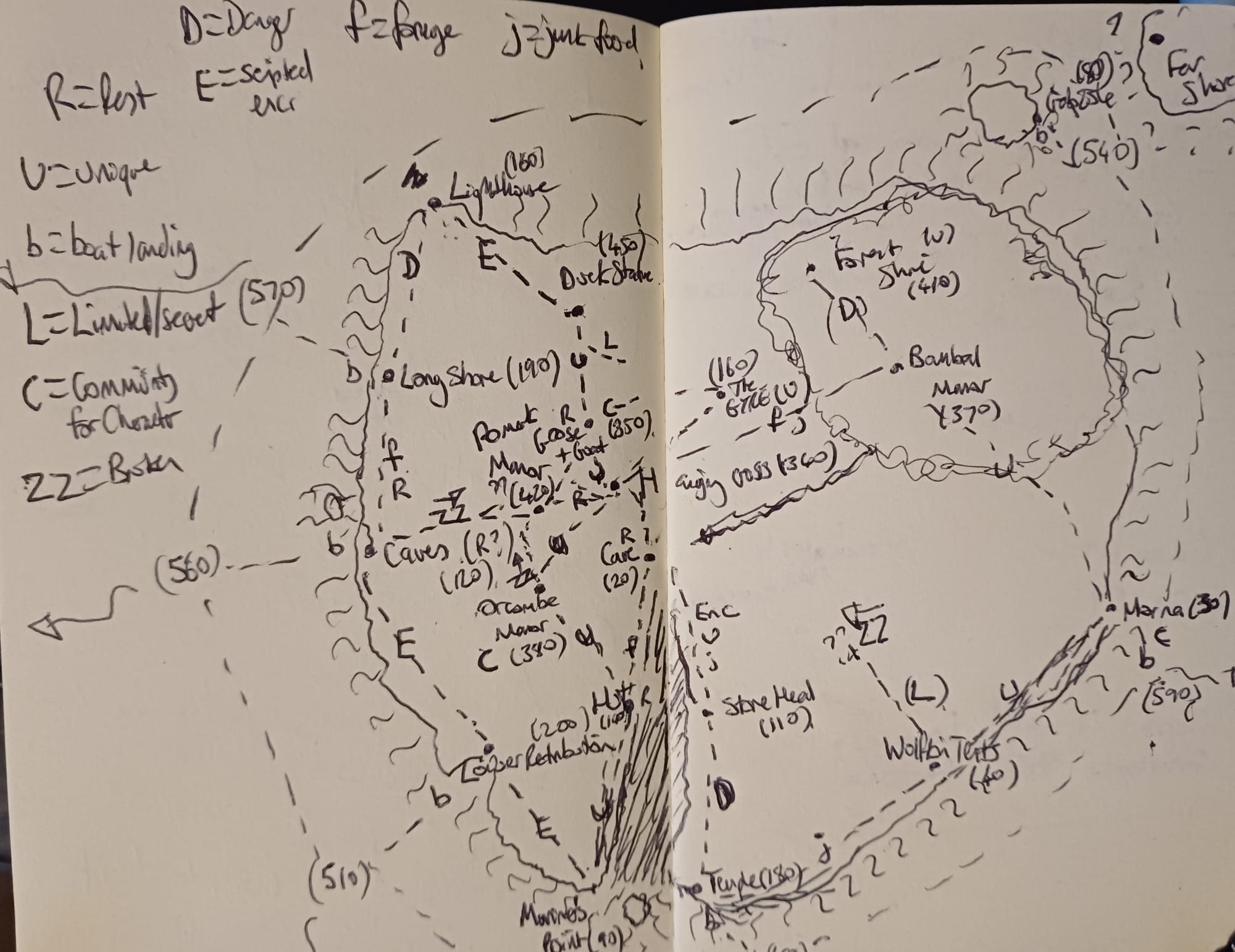
There was already enough complexity in wanting an environment that would develop over time, so adding dice in didn't feel to me like it would add anything. I didn't want it to be down to chance, I wanted it to be a delicious riddle with a satisfactory conclusion.
So there is combat in there but it's narrative, and the only skill test is in the ability to record an accurate map that will likely flow over multiple pages!
What advice would you have for anyone writing a mystery gamebook like the Bradfell Conspiracy?
Reverse-engineer the final discovery! In many ways, a mystery doesn't need to be difficult, it just needs to be unknown.
For both Portsrood Forest and Bradfell I wanted a storyline that would force you to travel around the place, which meant you need to discover one piece of information at a time, most likely in reverse order of the way the event took place.
So I came up with a sequence and then plotted back from that point.
Which gamebook are you proudest of writing?
I can't just pick one. I love the Portsrood Forest world, and while the Bradfell location I probably prefer, both feel like such an achievement for me for them to sit as a cohesive whole. They're daft, appropriately frustrating and - with a bit of work - beatable with some discipline.
But Solar War - the finale in the scifi trilogy - has 500 sections and took probably the most effort to get across the finish line so I feel very pleased with having finished the trilogy.
My honorary mention needs to go to You're a Wizard!, my children's title, which doesn't seem to interest other people so much but one of my own sons keeps on returning to it so that always puts a smile on my face.
What are your next big projects that you can talk about?
I have a third in the Portsrood series that's been sitting partly finished for far too long now. It has a title, a cover, a map, and I've probably written 300 of the 400 sections.
So I really hope I find the time and energy to get that one out there - it will be the best yet, and the main character has a name that makes me laugh to even think about it.
Where can people find you online?
With some difficulty, probably! I'm now rarely on Facebook and my author website got replaced by my professional website when I lost my job and started working for myself a few years ago.
I'm not hidden, just not "Samuel Isaacson, gamebook author" in many places at the moment...watch this space!
Is there anything else you would like to talk about?
I'm always happy to chat 😄
Finishing Up
If you haven't tried one of Sam's gamebooks, track one down!
There are many more articles on Rand Roll. Plus the 100 Endings Discord. I also create Generators at Chaos Gen and have a monthly random tools Newsletter.